Tuesday, November 3, 2009

Mercedes Benz SLS AMG


The Mercedes-Benz SLS AMG embodies a blend of consummate automotive fascination and high tech. The super sports car delivers a compelling mix of purist styling, consistent lightweight design and superior driving dynamics. At the same time, the Mercedes-Benz SLS AMG fully lives up to all the expectations of hallmark Mercedes everyday practicality and optimum safety. In essence, the new 'Gullwing' offers the ideal synthesis of the strengths of Mercedes-Benz and AMG.

The new super sports car from Mercedes-Benz and AMG makes for an alluring proposition with its unrivalled technology package: aluminium spaceframe body with gullwing doors, AMG 6.3-litre V8 front-mid engine developing 420 kW/ 571 hp peak output, 650 Nm of torque and dry sump lubrication, seven-speed dual-clutch transmission in a transaxle configuration, sports suspension with aluminium double wishbones and a kerb weight of 1620 kilograms based on the DINstandard - this superlative combination guarantees driving dynamics of the highest order. The ideal front/rear weight distribution of 47 to 53 percent and the vehicle's low centre of gravity are testimony to the uncompromising sports car concept. The 'Gullwing' accelerates from 0 to 100 km/h in 3.8 seconds, before going on to a top speed of 317 km/h (electronically limited). The fuel consumption of 13.2 litres per 100 kilometres (combined) puts it at the front of the competitive field (all figures provisional).

 
The AMG 6.3-litre V8 engine delivers its abundant power via an ultra-light carbon-fibre driveshaft at the rear axle - similar to the set-up used on the DTM C-Class racing touring car. The dual-clutch transmission is mounted at the rear (transaxle principle) and is connected to the engine housing via a torque tube. A carbon-fibre shaft rotates at engine speed in the torque tube. The advantages of this sophisticated solution are associated with the rigid link between the engine and trans-mission and, in turn, the optimum support for the forces and torque generated.

A new AMG SPEEDSHIFT DCT 7-speed sports transmission takes care of power transfer. The dual-clutch transmission boasts fast gear changes with no loss of tractive force - in as little as 100 milliseconds. The driver has a choice of four different driving modes: "C" (Controlled Efficiency), "S" (Sport), "S+" (Sport plus) or "M" (Manual) along with a RACESTART function. In the Sport, Sport plus and Manual modes the automatic double-declutching function is active; all the modes can be selected conveniently via the rotary control in the AMG DRIVE UNIT. Optimum traction comes courtesy of the mechanical differential lock, which is integrated in the compact transmission casing.


The Mercedes-Benz designers took their inspiration from aircraft construction when styling the interior - immediately bringing an aircraft cockpit to mind. The characteristic styling feature is the dashboard, whose powerful and dramatic wing shape makes for an impression of width. Strikingly integrated into the dashboard are the galvanised air vents with their adjustable, cruciform nozzles and Silver Shadow finish - their shape reminiscent of a jet's engines. The instrument cluster with its LED upshift indicator and two white backlit dial instruments add another decidedly sporty touch with their metallic Silver Shadow finish. The silver dials have red needles and a 360 km/h speedometer scale. As a central feature of the cockpit, the COMAND APSmultimedia system with its 7-inch screen is integrated between the two centre air vents.

The elongated centre console in matt metal similarly picks up on the design theme of the aircraft cockpit. It is home to the AMG DRIVE UNIT, which is inclined towards the Mercedes-Benz SLS AMG driver and allows them to choose their very own vehicle setup. The E-SELECT shift lever, whose styling recalls the thrust control of a jet, controls the AMG SPEEDSHIFT DCT 7-speed sports transmission. All the controls are made out of solid metal, with a high-sheen Silver Shadow surface.

 
Despite the low sitting position of just 369 millimetres in typical sports car fashion, the wide-opening gullwing doors make it easy to get in and out of the vehicle. At the design stage great attention was paid to the widest possible opening angle - it is a full 70 degrees. Equally importantly, the distance between the open doors and the road surface is a generous 1.50 metres, while the entry aperture between the open doors and the upper edge of the door sills measures no less than 1.08 metres. The entrance height, i.e. the distance between the road surface and the upper edge of the door sills is a very low 45 centimetres. As another important criterion for dignified access and egress, two gas-pressure struts positioned next to the door hinges require only very little pressure when opening and closing the doors - even at very low ambient temperatures.

The entire vehicle concept has been designed to achieve a centre of gravity that is as low as possible. This applies both to the low connection of the powertrain and axles as well as to the arrangement of the stiffness-relevant bodyshell structure, which has been kept as low as possible. Examples include the rigid flexural and torque connections between the front and rear section and the safety passenger cell, which have been realised consistently using force paths that are as low as possible. This results not only in a low centre of gravity but also a harmonious and, thus, efficient force path in the vehicle structure.

Another prominent feature of the lightweight construction design is the transverse reinforcing struts at the front and rear axle that are integrated into the bodyshell structure. The sections connect the side members precisely where the highest forces act upon the bodyshell under dynamic cornering. The advantages of this sophisticated solution include unrivalled transverse rigidity and the absence of heavy secondary stiffening or supports.

Monday, November 2, 2009

Aston Martin Rapide


Aston Martin Rapide, one of the most eagerly awaited cars of 2009, was unveiled at the 63rd Frankfurt Motorshow. The elegant Aston Martin Rapide, functional yet luxurious, provides space for up to four adults combined with an engaging driving experience synonymous with all Aston Martins.

As the marque's first production four-door sports car, Aston Martin Rapide encapsulates core values of Power, Beauty and Soul; four 'swan wing' doors provide access to cosseting sports seats both front and rear bestowing occupants with ample accommodation. A 301 litre luggage compartment affords generous space for belongings for all four passengers whether they be sports bags or indeed, sets of skis, creating an Aston Martin which can be enjoyed on any occasion, anytime, anywhere.

Aston Martin Rapide's rear environment has been intelligently packaged to create a space where passengers feel a part of the driving experience with clear views to the front and sides. Comfort and support is supplied in the form of two hand trimmed individual seats and a personal face-level heating and air conditioning system. Aiding the practicalities of everyday use, the luggage compartment features a movable bulkhead to permit access from the rear cabin while the rear seats fold flat at the touch of a button to create a flat loading space increasing the luggage compartment from 301 litres to 750 litres.

At the heart of every Aston Martin lies an evocative engine providing effortless power and torque: Aston Martin Rapide features a hand-built 6.0-litre V12 engine producing 470 bhp (477 PS / 350 kW) with peak power being delivered at 6000 rpm and 600 Nm (443 lbft) peak torque at 5000 rpm. A specifically tuned six-speed Touchtronic 2 automatic transmission features as standard, allowing the driver to change gear automatically or manually via the steering column-mounted magnesium paddles.

First shown in 2006 in concept form at the Detroit Auto Show, the Aston Martin Rapide project received an immediate green light from Aston Martin's new shareholders in mid 2007 following the sale of the marque by the Ford Motor Company. In a little over two years, Aston Martin's design and engineering team have delivered a new car from the ground up. Aston Martin Rapide has been developed from the 'V/H Architecture' platform which already forms the backbone to Aston Martin's critically acclaimed line-up: the Aston Martin DBS, DB9 and Vantage range.


Director of Design,led the in-house design team which penned the Aston Martin Rapide said: "Like a race horse standing still, you can see its power and elegance, the shape of Aston Martin Rapide's rear haunches are muscular conveying the power that lies beneath while its low stance produces a powerful look.

The Aston Martin Rapide suggests a new world of possibilities for the Aston Martin enthusiast, a car capable of long distances at high speed, providing both a driver-focused environment and refined and cosseting interior for its passengers. The Aston Martin Rapide turns every journey into an event.

The Aston Martin Rapide brings pure function to the Aston Martin experience, a car that combines everyday practicality with elegant form and exceptional power. "Now there is an Aston Martin for every type of sports car customer regardless of the demands of their lifestyle," says Aston Martin Chief Executive, Dr. Ulrich Bez, "the Aston Martin Rapide is our most versatile product, bringing a new benchmark of luxury and refinement to both driver and passenger."

Within the flowing, muscular form of the Aston Martin Rapide, four individual seats and a spacious luggage compartment present a new type of rapid family transportation; swift, spacious, dynamic and social. Four adults can enjoy the Aston Martin Rapide in complete comfort, savouring the ride quality, the ambience of the hand-trimmed cabin and the sensation of speed and dynamism derived from the low seating position and excellent visibility.


The Aston Martin Rapide also excels as an occasional load-hauler, with individually folding rear seats - at the push of a button - to allow the rear luggage space to expand to up to 750 litres, facilitating the occasional bulky impulse purchase, or creating the ultimate long-distance holiday cruiser, able to transport skis or hiking equipment, hatboxes or trunks across continents with ease. The rear luggage compartment is accessed through an opening tailgate and separated from the cabin by a movable bulkhead that can be set to create a unified internal space running from the dashboard through to the tailgate, or provide a security cover for when the car is parked. Aston Martin offers a bespoke five-piece luggage set for the discerning traveller, tailored to precisely match your chosen interior trim.
 
Aston Martin Rapide as a lithe 'long distance runner', continuing Aston Martin's tradition of building high performance sporting grand tourers and distinct from the sprinter-like poise of the V8 Vantage or the muscular stance of the DBS.

Tuesday, October 27, 2009

ASIMO-Honda's Robot


Japanese robot Asimo Celebrated its ninth birthday party in Tokyo on Saturday October 31,2009 with 200 fans and friends, the robot is 1.3 meters tall and weighs 54 kilo’s. The name Asimo shortened for "Advanced Step in Innovative Mobility".


A spokesman for Honda said Asimo is now faster, more agile and generally more versatile. The robot's parents, including Honda Executive Chief Engineer Masato Hirose, hope the robot grows up to be useful member of cyber-society.

"It's a happy moment to be able to celebrate Asimo's ninth birthday. However, we'd like to see it grow up into a robot that will be able to be used in partnership with humans and evolve to be useful among humans," Hirose told reporters.

__________________________________________________________________________________
ASIMO-The Honda's Robot

ASIMO (アシモ, ashimo) is a humanoid robot created by Honda. Standing at 130 centimeters (4 feet 3 inches) and weighing 54 kilograms (114 pounds), the robot resembles a small astronaut wearing a backpack and can walk or run on two feet at speeds up to 6 km/h (4.3 mph), matching EMIEW. ASIMO was created at Honda's Research & Development Wako Fundamental Technical Research Center in Japan. It is the current model in a line of eleven that began in 1986 with E0.
Officially, the name is an acronym for "Advanced Step in Innovative MObility". Honda's official statements claim that the robot's name is not a reference to science fiction writer and inventor of the Three Laws of Robotics, Isaac Asimov.

Asimo can be operated from a workstation and also by a remote controller. Honda has also created a 3D CPU (consisting of three stacked dice: a processor, a signal converter and some memory) to power super Asimo. ASIMO runs the VxWorks operating system.
___________________________________________________________________________________

Recognition technology

With 2000's ASIMO model Honda added many features that enable ASIMO to interact better with humans. These features fall under 5 categories:
1. Recognition of moving objects
Using the visual information captured by the camera mounted in its head, ASIMO can detect the movements of multiple objects, assessing distance and direction. Common applications of this feature would include: the ability to follow the movements of people with its camera, to follow a person, or greet a person when he or she approaches.
2. Recognition of postures and gestures
ASIMO can also interpret the positioning and movement of a hand, recognizing postures and gestures. Because of this ASIMO can react to and be directed by not only voice commands, but also to the natural movements of human beings. This enables it to, for example, recognize when a handshake is offered or when a person waves and respond accordingly. It can also recognize movement directions such as pointing.
3. Environment recognition
ASIMO can recognize the objects and terrain of its environment and act in a way that is safe for both itself and nearby humans. For example, recognizing potential hazards such as stairs, and by stopping and starting to avoid hitting humans or other moving objects.
4. Distinguishing sounds
ASIMO's ability to identify the source of sounds has been improved, and it can distinguish between voices and other sounds. It can respond to its name, face people when being spoken to, and recognize sudden, unusual sounds such as that of a falling object or a collision, and face in that direction. It is also able to respond to questions, either by a brief nod, a shake of the head or a verbal answer.


5. Facial recognition
ASIMO has the ability to recognize faces, even when ASIMO or the human being is moving. It can individually recognize approximately 10 different faces. Once they are registered it can address them by name.
___________________________________________________________________________________

Network integration

Utilizing networks such as the Internet, ASIMO can provide information and function better for various commercial applications, such as reception. Its abilities fall under 2 categories:
1. Integration with user's network system
By connecting with a user's network ASIMO can offer many useful functions such as greeting visitors and informing personnel of the visitor's arrival by transmitting messages and pictures of the visitor's face and guide visitors to a predetermined location.
2. Internet connectivity
By accessing information via the Internet, ASIMO can, for example, become a provider of news and weather updates.

Wednesday, October 21, 2009

Mercedes Benz SLR MacLaren Roadster

Driving Enjoying,Styling Impulsive.


The Mercedes-Benz SLR McLaren is an Anglo-German supercar jointly developed by Mercedes-Benz and McLaren Automotive, built in Portsmouth and the McLaren Technology Centre in Woking, Surrey, England. Daimler AG, owner of Mercedes-Benz, also owns 40% of the McLaren Group.

Due to the presence of the automatic gear box, front mid-engined arrangement and its driving characteristics lead some commentators to classify the SLR McLaren as a GT whose rivals can be considered to be vehicles like the Aston Martin DBS V12 and Ferrari 599 GTB Fiorano.


Brakes

The SLR features Sensotronic, a type of brake-by-wire system. The brake discs are carbon-ceramic (in the front only) and provide better stopping power and fade resistance than steel discs when operating under ideal working temperature. Mercedes-Benz claims these discs are fade resistant to 1,200 °C (2,200 °F). The front discs are internally vented and 370 mm (15 in) in diameter. 8 piston calipers are used. Rear discs are 360 mm (14 in) in diameter with 4 piston calipers. During wet conditions the calipers automatically skim the surface of the discs to keep them dry.
To improve braking performance there is an automatic air brake, when engaged the rear elevation angle of the rear spoiler is set to 65 degrees. The additional rear downforce in addition to the markedly increased aerodynamic drag increases peak deceleration ~90%.

Aerodynamics

The SLR features active aerodynamics; there is a spoiler mounted on the rear integral air brake flap. The spoiler increases downforce depending on its angle of elevation (angle of attack). At speeds above 95 km/h (59 mph) the spoiler/brake automatically raises to 10 degrees (15 in 722 edition), when demanded via the driver's switch, the elevation can be increased to 30 degrees (35 in 722 version) for increased rear downforce, at the cost of increased steady state drag.
_____________________________________________________________________________________
Engine Technology


The SLR sports a 232 kg (510 lb) hand-built 5,439 cc (5.439 L; 331.9 cu in), supercharged, all-aluminium, SOHC V8 engine. The cylinders are angled at 90 degrees with three valves per cylinder and lubricated via a dry sump system. The compression ratio is 8.8:1 and the bore and stroke is 97 millimetre (3.82 in) and 92 millimeters (3.62 in), respectively. The Lysholm-type twin-screw supercharger rotates at 23000 revolutions per minute and produces 0.9 bar (13 psi) of boost. The compressed air is then cooled via two intercoolers. The engine generates a maximum power of 626 PS (460 kW; 617 hp)@6500rpm and maximum torque of 780 N·m (580 lb·ft)@3250-5000rpm

Unlike most of its contemporaries, its engine is front-mid mounted. McLaren took the original concept car designed by Mercedes and moved the engine 1 metre (39.4 in) behind the front bumper, and around 50 centimetres (19.7 in) behind the front axle. They also optimized the design of the center firewall.

The SLR 722 can go from 0 to 100 km/h (62 mph) in 3.6 seconds, 200 km/h (120 mph) in 10.2 seconds and 300 km/h (190 mph) in 21.4 seconds and can reach a top speed of 337 km/h (209 mph).


Roadster
2008 Mercedes-Benz SLR McLaren roadster

A roadster version of the SLR went on sale in September 2007 for £350,000 ($711,065 U.S.). It uses the same supercharged V8 AMG power plant as its coupé siblings, developing 626 PS (460 kW; 617 hp), to propel it to a top speed of 332 km/h (206 mph) and enable 0-100 km/h (62 mph) acceleration time of 3.8 seconds.

However, being a convertible the roadster will have to be burdened with extra weight and this will affect performance and handling. The Roadster's roof, however, is made from a "newly developed material" and hence will not take the form of a folding metal arrangement, as is now common on many modern cars. Following a manual unlatching, it takes a mere 10 seconds to fold away electrically. According to an official document from Mercedes, the cabin of the roadster is capable of allowing conversation between driver and passenger up to a speed of 200 km/h (120 mph) with the roof retracted. This roadster is aimed to compete against other sports cars such as the Pagani Zonda F Roadster.

722 GT (2007-)
One of 21 SLR 722 GTs at the Goodwood Festival of Speed.

The 722 GT is a tuned version of the SLR 722 which is developed for a one-make racing series. The cars are built by Ray Mallock Ltd. with approval from Mercedes-Benz. The car features new wider bodywork to accommodate 19 in (482.6 mm) OZ racing wheels. The front grill vents are removed and larger, free flowing air extractors sit on the hood and flank the side of the car. The rear now has a racing wing and diffuser.

Under the body, the car has shed 398 kg (880 lb) and reduced its dry weight to 1,300 kg (2,900 lb) . The engine remains in relatively stock specification but now produces 680 PS (500 kW; 670 hp) and 830 N·m (610 lb·ft) at 1.75 bar (175 kPa) boost. Inside, the car is stripped out with only the essential functions being controlled from a carbon fiber binnacle. New carbon fiber door panels and full roll cage complete the transformation.

_____________________________________________________________________________________
Stirling Moss (2009-)

The SLR Stirling Moss is a limited (75 vehicles) edition of the series, which uses a speedster styling that does not include roof or windscreen. The design is based on the Mercedes-Benz 300 SLR race car. It is the last series of the McLaren SLR built under the partnership between Mercedes-Benz and McLaren.

The supercharged V8 engine is rated 650 PS (480 kW; 640 hp). The car's top speed is 350 km/h (220 mph) with acceleration from 0-100 km/h under 3.5 seconds. The car is approximately 200 kg (440 lb) lighter than the regular model.

Mercedes SLR


Incidentally, the two arms Mercedes 300 SLR went with a unique "air brakes" - the first will actively aerodynamic device in the history of car racing. The driver was back shield covering 0.7 m3, which is under braking opened with hydraulic drive towards airflow. At the speed of 250 kilometres per hour and it has a braking effect, reaching 42% of the efforts of the wheel brakes. In addition, "air brake" rear axle load increased, which further increased the intensity of braking.


Mercedes Benz Slr interior


SLR 2003 model year is different in appearance from his predecessor, and is internally. Unique in style, materials, and the most advanced technology to build a car pastors, many years of research and testing. To reduce weight in the construction of Mercedes-Benz SLR McLaren widely used aluminum.

V8 engine


Technical equipment new supporting is a familiar model Mercedes SL 55 AMG forced 5,3-litre turbo motor V8, developed with the help of AMG capacity equal to 626 horsepower and maximum torque of 780Nm is achieved at 3250 revolutions per minute. It remained at that level until 5000 before the failure of revolutions. Engine lubrication system was dry heat, more productive SCR, and other interesting solutions specialists' formula 'team McLaren. From zero to one hundred kilometres per hour and car for 3,9- second much more quickly, and up to 200 km / h in 10.6 seconds. Maximum speed car is 334 kilometres per hour. This design, in fact, may be more. In addition, 3-valve technology and four metal catalytic super power units monitor the stringent environmental standards for Euro-4, which takes effect in 2005.

Available in a five-engine "automatic", which, in addition to the basic mode of operation is three - "Sport", "Supersport" and "Race". These regimes are different speeds of transmission and the algorithm work.
In addition, the Mercedes SLR can compete as electric hydraulic braking system (SBS), in which the ceramic brake discs, as well as a sophisticated stability control system. Furthermore, the gadget is fitted with a set of airbags, which includes even the cushion to protect the legs passengers on impact, and other security systems. Incidentally, the design of car pastors of Mercedes applied technology and materials to protect cabins in the accident, used to Formuly-1 Cup. The basic version Mercedes SLR will be staffed 18-dyuymovymi wheels with 245/40 tires in front and size 295/35 at the rear. Inch wheels can be ordered as an option.

Friday, October 9, 2009

Honda Marine

HondaJet HA-420


Honda began research into small sized business jets in the late 1980s, using engines from other manufacturers. The Honda MH02, an organic matrix composite prototype, was fabricated and assembled at Mississippi State University's Raspet Flight Research Laboratory in the late 1980s and early 1990s.

The HondaJet made its maiden flight in December 2003 and was debuted to the public at the EAA AirVenture air show.Honda announce it would commercialize the HondaJet, establishing the Honda Aircraft Company to seek both type and production certification of the HondaJet with production to take place in the United States. The company began taking customer orders for HondaJet in the fall of 2006, and estimates deliveries to begin in 2011 at a price of approximately $3.65 million US. The plan is to build 70 jets per year.In August 2006 Honda and Piper Aircraft announced a partnership to market the HondaJet.
___________________________
Technology

HondaJet falls under the category of Very Light Jet (VLJ). Usually, a VLJ is able to fly in the max range of 1320 NM at 380 knots, but the HondaJet is able to achieve 420 knots with the similar max range.The HondaJet produces a range 1180 nautical miles with 30-35% higher fuel efficiency when compared to other jets with equivalent performance.

By the year 2003, HondaJet took its first flight. And in 2005, in conjunction with the Experimental Aircraft Association (EAA) AirVenture in Oshkosh, Wisconsin, HondaJet made its first public appearance.The engine used during the flight was the HF118 turbofan jet which produces 1670 pounds of static thrust (lbst) during take-off.

After more than 20 years of research and development, HondaJet's technology in aviation industry was well-received with its over-the-wing engine mount configuration - a patented design invented by Honda engineers which reduces drag and minimizes shock wave.Other innovations include the natural laminar flow (NLF) wing and fuselage nose which also reduces drag. The advanced all-composite fuselage structure was developed with the intention to provide the aircraft with a light structure and greater interior volume.Its cabin offers its passengers with 2 configurations: 2 pilots and 5 passengers; and 2 pilots and 6 passengers.


General Characteristics
- Crew: 1-2 crew members[7]
- Capacity: 5 passengers
- Length: 41.70 ft (12.71 m)
- Wingspan: 39.87 ft (12.15 m)
- Height: 13.21 ft (4.03 m)
- Useful load: 644lbs ()
- Max takeoff weight: 4,173 kg (9,200 lb)
- Powerplant: 2× GE Honda HF120 turbofan engines, 1,880lbf each (Bypass Ratio= 2.9) (8.04kN) each

HondaJet’s new interior concept was introduced with a special focus on human fit, ergonomic efficiency and safety for the customer. Honda has created a cabin environment befitting the company’s reputation for world-class engineering and attention to detail in the quality of materials, design and construction.

HondaJet’s new cockpit design incorporated learning from extensive study on the human factors of pilots and pays special attention to the layout. The production version of HondaJet will also incorporate an all-glass avionics package developed for HondaJet by Garmin®.

Honda also provided a glimpse into potential additional production colors, with colors on display including a brilliant HondaJet Silver Metallic ; a rich HondaJet Red; as well as versions in HondaJet Green and HondaJet Yellow.

“From the beginning, it has been our goal to bring new value to the field of aviation,” said Michimasa Fujino, president & CEO, Honda Aircraft Company. “With a focus on innovation we will continue our efforts to deliver a product of outstanding performance, quality and comfort with the best sales and service operation to exceed customer expectations.”


Honda decided to go with an unusual over-the-wing podded engine configuration, a feature developed on the innovative Vereinigte Flugtechnische Werke VFW-614 decades earlier, which allows for more space within the fuselage and reduction of drag at higher speeds. The fuselage itself is made from lightweight composite materials, while the wings are made from structurally reinforced single sheets of aluminum. The use of a single sheet allows for a smoother surface than more conventional methods. Honda claims that the combination of lightweight materials, aerodynamics and the efficient engines gives the HondaJet a 30-35% higher fuel efficiency than similar aircraft.

Honda began developing its own small turbofan engine, the HF118, in 1999. This led to the evolution of the HF120, which was developed with GE Aviation under the GE Honda partnership, and was test-flown on a Cessna Citation and on a modified Boeing 727-100. The engine features a single fan, a two-stage compressor and a two-stage turbine. Further design testing on wing shape and design were done on a T-33 Shooting Star, modified by AVTEL Services, Inc, and flight tested at the Mojave Airport.

The aircraft is equipped with a Garmin G1000 glass cockpit system (i.e. most of the cockpit readouts are presented on flat-panel displays).


Performance
- Maximum speed: 420 KTAS (778 kmh, 483 mph)
- Cruise speed: 420 KTAS (FL300[8])
- Range: 1400 nm (1611 mi, 2,593 km) (VFR Range)
- Service ceiling: 43,000 ft (13,107 m)
- Rate of climb: 3990 ft/min (20.27 m/s)


The avionics for HondaJet was Garmin G1000 glass cockpit.

_____________________________________________________________________________________

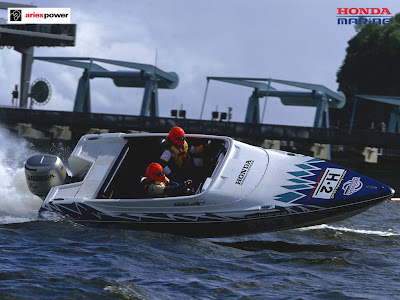
Honda Marine-It's all about Power


Honda Marine - Home of 4-stroke Honda outboards from 2 to 225 HP. Find outboard engine specs, Propellers, Flush Kits and other Accessories, and a Honda Outboard Motor dealer near you. Honda Marine Outboard Motors - Outboards, Dealers, Accessories


Honda & the Environment
Technology and the Environment
Honda has long been recognized as a leader in the development and application of new technologies designed to reduce the environmental impact of its products through improved fuel efficiency and reduced emissions.

Honda Marine is no exception to this legacy of environmental leadership. Since 1964, Honda has manufactured only four-stroke outboard motors, which are approximately 90 percent cleaner, 50 percent more fuel-efficient and 50 percent quieter than typical two-stroke outboard motors. More important, four-stroke motors do not release oil directly into the water.

In 1998, Honda became the first company to introduce an entire line of high performance outboard motors that met the Environmental Protection Agency's (EPA's) year 2006 emission standard.

Environmental Sponsorships
Honda Marine is a proud sponsor and dedicated partner to environmental organizations whose members work and volunteer to protect our planet's natural resources.

Learn more about our environmental sponsorships and find out how the organizations are working to protect and restore the nation's major rivers and their watersheds.

Corporate Leadership
Beyond the development of cleaner products, Honda also has sought to reduce the environmental impact of all its activities. Launched in 1998, Honda's Green Factory planning concept is the foundation of the company's eco-friendly manufacturing practices, which seek to minimize factory emissions and waste throughout the manufacturing process.

Further, Honda's commitment to environmental responsibility is reflected in its portfolio of ISO certifications. All of the company's facilities throughout Japan and its major manufacturing facilities in the rest of the world have obtained ISO 14001 certification – an internationally recognized set of standards for environmental management systems. In addition, in 1999 Honda launched its Green Dealerships program in Japan, which puts Honda dealerships at the forefront of customer and community service. It also positions dealers to earn ISO 14001 certification, based on environmentally responsible disposal of used cars, improved energy efficiency, and other measures.


HONDA'S CORE TECHNOLOGY
Honda is the world’s preeminent manufacturer of engines, selling nearly 20 million units globally across all product lines in 2004. This high production volume, coupled with the company’s deep level of experience and commitment to precision manufacturing techniques, has allowed Honda to remain the leader in 4-stroke technology.

Honda engineers work to ensure that every Honda outboard model – ranging from 2 to 225 horsepower – sets the standard for fuel efficiency and ease of operation, while staying true to the core Honda attributes of durability, quiet operation, quality, and reliability. Honda’s advanced 4-stroke technology reduces the user’s cost of operation because no oil is needed in combustion, and, like all Honda engines, the marine models offer Ultra-Low Emissions, exceed the 2006 EPA emissions standards and comply with strict ratings as determined by the California Air Resource Board (CARB).

Honda continually perfects its marine engine line by incorporating technologies from its highly advanced automotive and racing heritage. The unparalleled performance, power, and reliability of the Honda Marine 4- stroke engine line is attributed to a number of exclusive technological features such as VTEC™, Honda’s Variable Valve Timing and Lift Electronic Control. First debuting in the high-performance Acura NSX supercar, VTEC™ technology has since been integrated into the designs of the BF225, BF150 and BF90 marine engines, providing these flagship models a unique blend of power, torque, and efficiency at any speed.

Boosted Low Speed Torque (BLAST™), Dual-Stage Induction, Lean Burn
Feedback, a 3-Way Cooling System, and a 4-Front Corrosion Protection System (which includes a patented paint process, sacrificial anodes and stainless steel components) are just a few of the other innovative design components that conspire to deliver excellent power and durability throughout the entire Honda Marine engine line.

Honda Marine outboard engines also are low maintenance thanks to precision engineering which results in tighter tolerances, better performance, and quieter and longer lasting engines.


FUEL INJECTED Engines

Honda fuel injected engines are less susceptible to fuel deterioration problems than carbureted engines. Fuel injected engines store fuel in a Vapor Separator, a large reservoir with a float and vent similar to a carburetor. The vent, however, is filtered, so the fuel inside has less exposure to the air and stays fresh longer.

Honda recommends using a fuel stabilizer when storing your fuel injected engine for more than 60 days. Add fuel stabilizer to your boat's fuel tank(s) and run the engine in the water, under a slight load if possible, for 15 to 20 minutes.

Tuesday, September 8, 2009

Driving Enjoying,Styling Impulsive.

Ferrari F430


The Ferrari F430 is a sports car produced by the Italian automaker Ferrari from 2004 to 2009, as a successor to the 360. It debuted at the 2004 Paris Motor Show.European left-hand drive,Malaysia right-hand drive were sales began in country, but right-hand drive sales did not start until Spring 2005, and the North American market did not get the F430 until Summer 2005.[citation needed] Its replacement, the Ferrari 458 Italia was unveiled on the 28th July 2009, and is expected to go on sale in Spring 2010.Ferrari for Malaysia was available for Auto City of Butterworth,Afcar-Auto of Penang,and so on.


The F430's all-aluminum chassis was produced in partnership with Alcoa and is virtually identical to that of the previous model, the Ferrari 360. In the F430 it has been slightly re-worked and improved with extra stiffening beams around the floor pan. The car shares parts with the 360, including the roof, doors, front windshield, and passenger compartment-to-engine glass. Internally, both cars are referred to with the same model number (F131), although the F430 has the Evoluzione tag attached to show that it features some major changes. Internally, the car is simply known as the "Evo". On May 12, 2009, Ferrari announced a one-off F430 painted silver and gold to help with the Earthquake relief in Italy. This F430 will be the last F430. It will be replaced by the all new 458 Italia.Ferrari's prices in Malaysia was about RM1million++ for the cheapest.


The F430 features a restyled body and a 4.3L V8 petrol engine derived from a shared Ferrari/Maserati design. This new power plant is a significant departure for the F430 line: the engines of all previous V8 Ferraris were descendants of the Dino racing program of the 1950s. This fifty year development cycle came to an end with the entirely new 4.3L, the architecture of which is expected to replace the Dino-derived V12 in most other Ferrari cars. The engine's output specifications are: 490PS (483hp) at 8500 RPM and 465 N·m (343 lb·ft) of torque at 5250 RPM. The F430 will reach a top speed of 196 mph (315 km/h).[citation needed]

Ferrari~Impulsive Spirit for whole of your life~


The F430 includes the E-Diff, a computer-controlled limited slip differential which can vary the distribution of torque based on inputs such as steering angle and lateral acceleration, a world's first.

Other notable features include the first application of Ferrari's manettino steering wheel-mounted control knob. Drivers can select from five different settings which modify the vehicle's ESP system, "Skyhook" electronic suspension, transmission behavior, throttle response, and E-Diff. The feature is similar to Land Rover's "Terrain Response" system.

The Ferrari F430 was also released with exclusive Goodyear Eagle F1 GSD3 EMT tires, which have a striking V-shaped tread design, run-flat capability, and OneTRED technology.

In the US the company requested an exemption from the airbag design requirements, which was eventually granted, allowing the car to continue to be sold in the US.

_____________________________________________________________________________________
_____________________________________________________________________________________